

Incoming mission / Hilo
Click the envelope to open your letter.
Dear Mission Designer,
Hilo needs your eyes in space.
Track active lava from Kilauea's 2018 eruption so Hilo-area responders know which areas are burning.
Choose how to observe the mission area from space. We need your first useful observations within 24 hours.
— Hilo research team
Fictional educational mission request
Open the full flight brief and science sources
Mission control / priority uplink
● ACTIVE TRAINING SCENARIO
Volcano alert: Hilo
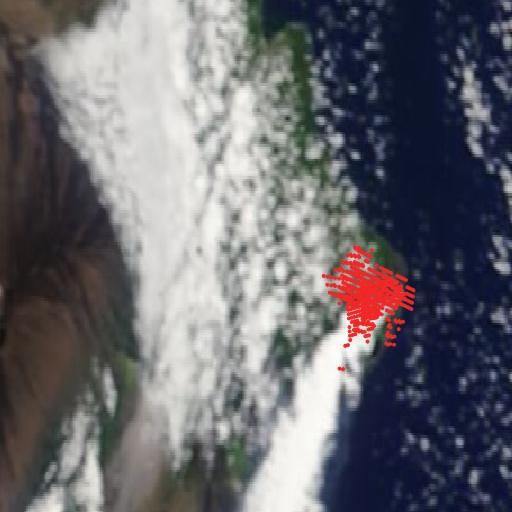
This training scenario replays Kilauea's 2018 eruption, when lava from new cracks in lower Puna covered whole neighborhoods.
Why space? Choose how to observe the mission area from space. Your spacecraft must find useful observations and transmit them to the ground team.
Archived NASA imagery · not a live emergency · source & date ↗
Mission science, assumptions & data sources
What the mission models
Find the active lava and get that data to responders within 24 hours.
Volcanic smog and rain clouds from the trade winds often hide the ground.
Results come from the deterministic simulation. Surface temperature is different from air temperature, and radar does not directly measure surface heat.
Source provenance
- NASA Suomi NPP VIIRS 375 m thermal anomalies (GIBS layer VIIRS_SNPP_Thermal_Anomalies_375m_All) · NASA-observed reference · Hazard cells = cells with Suomi NPP VIIRS 375 m thermal anomalies during the 2018 lower Puna eruption of Kilauea (eruption began 3 May; mission window 28 May - 10 June 2018), restricted to Kilauea's summit and rift zones (south of 19.6 N) and excluding hot spots already present on 2018-04-10..2018-04-15; seen on two or more days = strongest. Detections from 2018-05-03 count; eventDay = first mission day (from 2018-05-28) a cell was hot, 0 if it was already hot before the window.
- Mission: Possible cloud and detectability model · Educational model · cloudProbability (baseline 0.5 for this volcano setting) and detectability are seeded educational estimates, not observations.